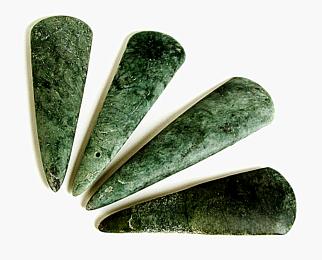
 En août 2007, alors qu'ils ramassent des coquillages sur la plage du Petit-Rohu, à Saint-Pierre-Quiberon (56), deux vacanciers découvrent fortuitement quatre grandes lames de haches polies en roche verte », explique, dans un communiqué, le musée de la préhistoire de Carnac (56). « En comparant ces objets avec ceux du Musée de Carnac, la Française Sonia Hoba et le Britannique Adam MacHale mesurent tout l'intérêt de la découverte : bien connus des préhistoriens, ces objets de prestige datent de l'époque néolithique. Ils sont réalisés en jadéite, roche d'origine alpine exploitée dès 5.200 ans avant J.-C. dans le nord de l'Italie ». Une équipe pluridisciplinaire de recherche, dirigée par Serge Cassen (CNRS), intervient pendant un an, à chaque grande marée. « Les résultats des investigations scientifiques montrent qu'il y a 6.500 ans, alors que le rivage devait être éloigné d'environ 500 m, les haches ont été enfouies au pied d'un important affleurement rocheux, dans un milieu marécageux, entre terre et mer. Déposées verticalement, par paire, elles avaient peut-être été placées dans un étui en cuir, comme en témoignent des résidus noirs adhérant encore à leurs faces ». Un alignement de menhirsÀ une douzaine de mètres du lieu de dépôt des haches, les archéologues découvrent un ensemble de 45 blocs de pierres formant au moins un alignement de menhirs aujourd'hui submergé. L'un d'eux est encore debout. Au pied d’une stèle, une nouvelle petite lame de hache a même été découverte. » Selon le musée de Carnac, « aucun ensemble de cette importance n'a été retrouvé dans la région depuis le XIX e siècle » Juste après cette découverte, une équipe de recherche, dirigée par Serge Cassen du CNRS, se rend sur place pour étudier sur terre et sous la mer l’étendue du site. Archéologues, palynologues, anthracologues, géologues, plongeurs… ont travaillé sur les lieux à chaque grande marée, jusqu’? cet été 2008.« Elles avaient peut-être été placées dans un étui en cuir, comme en témoignent des résidus noirs adhérant encore à leurs faces. » Les chercheurs ont par ailleurs remarqué que sur la plage, des niveaux de tourbes et d’argiles conservent des empreintes d’animaux (bovidés, porcs ou sangliers) ainsi que des sillons de labours. Ces derniers témoignent soit de cultures anciennes, soit d’exploitation de sel. article du journal le télégramme
NEOLITHIQUE - Les recherches archéologiques le long des côtes de Quiberon et au large de la presqu’île ne cessent de confirmer l’intuition des chercheurs: les alignements de Carnac (environ 3000 pierres recensées) ne sont que la (petite?) partie émergée d’un ensemble beaucoup plus vaste. Dernière découverte en date, dévoilée par le musée de la préhistoire de Carnac: l’alignement de 27 stèles sous les eaux près de la plage de Petit Rohu, à St Pierre 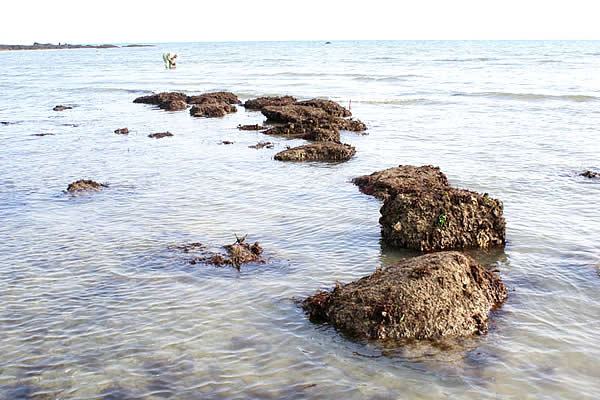
(Photo E.Vigier, alignement de menhirs à marée basse)
En août 2007, deux pêcheurs à pied avaient découvert fortuitement sur cette plage un véritable petit trésor archéologique: quatre lames en jadéite, une roche particulièrement rare et dure d’origine alpine, exploitée dans le nord de l’Italie, quelques millénaires avant Jésus Christ. Des objets de prestige qui prouvent une nouvelle fois, avec les tombeaux gigantesques mis à jour dans la région, que ce secteur était un des centres de pouvoir les plus importants d’Europe au néolithique.
“On retrouve ces haches de l’Ecosse à la Scandinavie ou la Bulgarie, mais elles ne sont nulle part aussi grandes, aussi belles et en quantité aussi importante que celles que l'on a découvertes dans le Morbihan”, souligne Serge Cassen, responsable du laboratoire de préhistoire de l’université de Nantes et directeur des recherches sous-marines dans la baie de Quiberon.
Cette découverte initiale a incité les archéologues à poursuivre des investigations au delà du rivage qui leur ont permis de retrouver un nouvel alignement sous-marin. Au large de Saint-Pierre et Quiberon, en effectuant des recherches au sonar, ce sont toutefois pas moins de 300 menhirs couchés sur les fonds marins sur une dizaine de rangées longues de 400 mètres, qui ont été repérés ces dernières années. Un véritable “Carnac sous-marin” qui a encore fait l’objet de plongées cet été pour en valider la nature et l’étendue.
“Nous avons aussi retrouvé des stèles sous la mer au large de la Trinité, de Locmariaquer et dans la ria d’Etel, précise Serge Cassen.
Ces alignements ont été engloutis, parfois sous plusieurs mètres d'eau, au cours des changements géologiques et climatiques qui sont intervenus depuis le néolithique.
"Entre 10 000 et 5000 ans avant Jésus Christ, la progression des eaux était beaucoup plus rapide que celle dont on s’inquiète aujourd’hui”, indique Serge Cassen.
Selon le chercheur, les alignements sous-marins ne sont en tout cas que la continuité des rangs de menhirs qui attirent à Carnac des dizaines de milliers de visiteurs et ils devraient apporter des informations précieuses pour en percer le mystère.
“D’abord, ils n’ont fait l’objet d’aucune restauration et ils nous apportent des éléments de datation nouveaux, souligne t-il. Mais on manque toujours d’un cadre conceptuel pour percer l’intrigue que représente les alignements de Carnac, toujours sujet des mêmes poncifs et des élucubrations les plus folles”.
Fort des découvertes de ces dernières années sous les eaux du golfe du Morbihan, Serge Cassen travaille précisément à un ouvrage (parution prévue en 2009) qui développera sa propre théorie sur la question. En attendant, les quatre haches en jadéite découvertes sur la presqu'île par des amateurs de coquillages seront remises officiellement au musée de la préhistoire de Carnac le 20 septembre à l'occasion des journées du patrimoine.
Pierre-Henri ALLAIN article du site http://www.liberennes.fr/libe/2008/09/nouvel-aligneme.html Découverte archéologique - Ma-Tvideo France3 L'équipe du CNRS qui travaille dessus depuis un an parle de découvertes majeures. Découvertes au pluriel effectuées complètement par hasard à St-Pierre-Quiberon. En fait: 5 haches datant de 5.200 avant notre ère ainsi qu'un alignement de menhirs la plupart du temps immergés.
Découverte archéologique - Ma-Tvideo France3 L'équipe du CNRS qui travaille dessus depuis un an parle de découvertes majeures. Découvertes au pluriel effectuées complètement par hasard à St-Pierre-Quiberon. En fait: 5 haches datant de 5.200 avant notre ère ainsi qu'un alignement de menhirs la plupart du temps immergés. In August 2007, holidaymakers discovered two pairs of polished jadeitite axeheads that had been set vertically in gravelly silt on the beach of Porh Fetan, at a location called Petit Rohu reports the Antiquity Journal. The shape and material of these axeheads allowed them to be identified straightaway as being of Alpine origin, in common with a number of axeheads found in the region (Bailloud et al. 1995; Pétrequin et al. 1997). Archaeological fieldwork, both on the land in the vicinity of the findspot and underwater, was subsequently carried out by the Laboratory of Archaeological Research (CNRS – Nantes University), in order to examine the context of the findspot and to try to delimit the extent of the site.
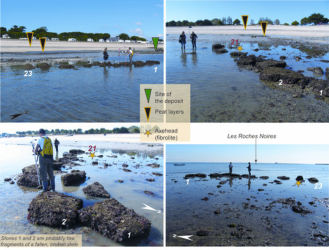
Initial fieldwork, carried out during the September spring tide, yielded no further artefacts but did produce evidence for at least one submerged stone alignment (image on the right), located to the south-east of the axehead findspot and several dozen metres away. Only one of the stones was still standing; the others had fallen. An initial plan of this structure was made at that point, and completed during the next investigation, which took place during the October spring tide. The structure is readily distinguishable from a more recent stone structure, relating to fishing, located 800m away. A third investigation, carried out during the last spring tide of the year in November, led to the discovery of a fifth axehead, this time of fibrolite, found resting against one of the fallen stelae.
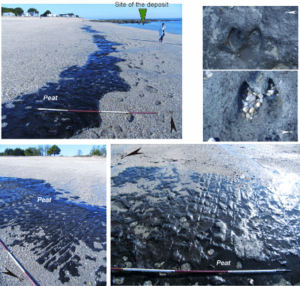
<<Antiquity Journal
Peaty soils had been intermittently observed over several years, buried beneath marine sand; these are being progressively eroded away by the force of the sea, as their sand cover becomes thinner (image to the left). These soils preserve marks, criss-crossing each other in places, which relate either to cultivation or to salt extraction; and there are also hoof-prints of ungulates (cattle and pigs). This palaeoenvironmental context allows us to argue that the axeheads had been deposited in a marshy environment that had developed behind a dune system, at the foot of a remarkable granite outcrop. Sea level rise since the mid-fifth millennium BC – the likely date at which the axeheads were deposited – means that the shore has advanced by some 500m since then (Cassen & Pétrequin 1999).
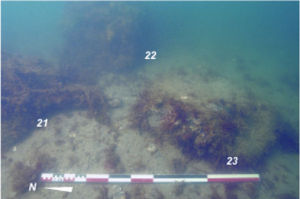 Today, the findspot of the stone alignment and axehead deposit lies beneath 5m of sea (image to the right). These architectural vestiges join the list of recent discoveries (since 1998) of submerged monuments in the Bay of Quiberon, the Etel estuary and the Gulf of Morbihan. Of particular note is the site of Kerbougnec, several hundred metres to the north of Rohu, where a dozen lines of fallen stones, extending over at least 400m, have been found under the sea (Cassen & Vaquero Lastres 2003). This site is comparable in stature to the Carnac alignments. At the foot of the largest stela (8m long), a fibrolite axehead was found in 2006, in conditions similar to those obtaining at Petit Rohu. Today, the findspot of the stone alignment and axehead deposit lies beneath 5m of sea (image to the right). These architectural vestiges join the list of recent discoveries (since 1998) of submerged monuments in the Bay of Quiberon, the Etel estuary and the Gulf of Morbihan. Of particular note is the site of Kerbougnec, several hundred metres to the north of Rohu, where a dozen lines of fallen stones, extending over at least 400m, have been found under the sea (Cassen & Vaquero Lastres 2003). This site is comparable in stature to the Carnac alignments. At the foot of the largest stela (8m long), a fibrolite axehead was found in 2006, in conditions similar to those obtaining at Petit Rohu.
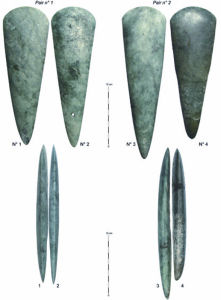
Initial spectroradiometric analysis of the two pairs of axeheads, undertaken as part of the Agence Nationale de la Recherche-funded Programme Jade (2007–2009; directed by Pierre Pétrequin and involving Serge Cassen, Michel Errera & Yvan Pailler), has confirmed that they are of jadeitite, originating in the Italian Alps. Indeed, at least three of the axeheads (Nos. 1–3, image at the top) certainly originated in the same block of jadeitite. Their surface finish attests to a considerable investment of time in order to achieve their mirror-like polish (which survives over part of their surfaces). This underlines the fact that these were not utilitarian axeheads, but instead were very special and precious artefacts. To summarise: this discovery on the Quiberon peninsula lends credence to several ancient accounts of other discoveries, which had previously been hard to validate from recent observations. It also allows us to gather and reassess information about Alpine axeheads within several investigative domains, namely: - Burial in a marshy context. The practice of depositing hoards of polished axeheads in wetland contexts is attested by many examples in Europe (Pétrequin et al. 2005). Marshy ground is the milieu par excellence for ensuring the transition between states of being and between this world and the Otherworld.
- Deposition as grave goods. This is the best-known of the archaeological contexts for finds of Alpine polished axeheads in Brittany; their discovery, from the time of the first explorations of the tombs in the Carnac area (‘tombeaux carnacéens’) in 1860, contributed to the renown of these monuments. Discovered both in impressive numbers (at Tumiac, Mané er Hroëck and Saint-Michel) and as more isolated deposits (at Mané Hui, Er Grah and Mané er Ouah Tihir), these axeheads greatly impressed their finders, and subsequent commentators, with their striking form, texture, colour and surface sheen. It was clear that these objects had been manipulated by an elite.
- Deposition in pairs. The deposition in the ground of pairs of polished stone axeheads is well known from the literature, but has only rarely been directly witnessed over the last few decades; most of the recent examples have been of axeheads made form Alpine rocks (Pétrequin et al. 2005). These pairings of axeheads clearly relate to Otherworldly beliefs in which divine twins and mirror effects constitute one of the ‘motors’ driving the world, or even act as an agent in its creation (Cassen 2000).
- Burial in a vertical position. The positioning of the Petit Rohu axeheads side by side and vertically, with their blades uppermost and pointing towards the sky, was not a casual act. This positioning is universally known and, within Brittany, one could cite as parallels the Alpine axeheads found in a chamber inside the famous Tumulus Saint-Michel, and the five axeheads found in the body of the earthen barrow Manio 2 at Carnac. The latter had been placed beside one face of the engraved stela that had been erected at the western end of one of the two cists of this monument (Le Rouzic et al. 1922).
- Relationship with stelae. The Manio 2 example is joined by others (including the aforementioned example in fibrolite from Kerbougnec) demonstrating a topographic and semantic contiguity between polished stone axeheads and standing stones. On the one hand the axeheads represent stone that has been extracted, shaped and polished; on the other, the stela represents a piece of rock that has been raised up to a vertical position, having sometimes been carefully prepared and dressed in a particular environment.
-
The relationship between Alpine axeheads and those of fibrolite. The earliest stone axeheads from Brittany are of fibrolite, a material that is hard to work and which has to be sawn, like jadeitite (Pailler 2007; a further similarity with Alpine rocks is the green colour of much fibrolite). Fibrolite axeheads have regularly been found accompanying those of Alpine rock dating to the fifth millennium BC. The importance of fibrolite as a material can be gauged by finds of fibrolite axeheads from north-western Iberia: here, in an area rich in fibrolite, the inhabitants rejected the circulation of Alpine rocks.
In brief, then, the Petit Rohu discovery illustrates the wealth of issues that surround Alpine stone axeheads.
The magnificent axeheads from Petit Rohu are to be placed on display in the Carnac Museum during the spring of 2008. They are witnesses to a massive, Europe-wide phenomenon – the circulation of Alpine axeheads – that links the Mediterranean to the Irish Sea and to the Baltic. Acknowledgements Translated by Alison Sheridan, member of the Programme Jade, who is warmly thanked by the authors for her valuable assistance. References - BAILLOUD, G., C. BOUJOT, S. CASSEN & C.T. LE ROUX. 1995. Carnac. Les premières architectures de pierre. Paris: Éditions du CNRS, CNMHS.
- CASSEN, S. (ed.) 2000. Eléments d’architecture. Exploration d’un tertre funéraire à Lannec er Gadouer, Erdeven, Morbihan. Constructions et reconstructions dans le Néolithique morbihannais. Propositions pour une lecture symbolique (Association Publications chauvinoises, Mémoire 19): 815. Chauvigny: Association Publications chauvinoises.
- CASSEN, S. & P. PÉTREQUIN. 1999. La chronologie des haches polies dites de prestige dans la moitié ouest de la France. European Journal of Archaeology 2 (1): 7–33.
- CASSEN, S. & J. VAQUERO LASTRES. 2003. Les Marches du Palais. Recherches archéologiques sur alignements de stèles et tertres funéraires néolithiques autour de la baie de Quiberon. Nantes: Laboratoire de préhistoire, Université de Nantes.
- LE ROUZIC, Z., M. PEQUART & ST-J. PEQUART. 1922. Carnac. Fouilles faites dans la région. Campagne 1921. Nancy-Paris-Strasbourg: Imprimerie Berger-Levrault.
- PAILLER, Y. 2007. Des dernières industries à trapèzes à l’affirmation du Néolithique en Bretagne occidentale (5500–3500 av. J.-C.) (British Archaeological Reports, International Series 1648). Oxford: Archaeopress.
- PÉTREQUIN, P., S. CASSEN, C. CROUTSCH & O. WELLER. 1997. Haches alpines et haches carnacéennes dans l’Europe du Vème millénaire. Notae Praehistoricae 17: 135–50.
- PÉTREQUIN P., M. ERRERA, S. CASSEN, G. BILLAND, C. COLAS, D. MARECHAL, F. PRODÉO & F. VANGELE. 2005. Des Alpes italiennes à l’Atlantique au Vè millénaire, les quatre grandes haches polies de Vendeuil et Maizy (Aisne), Brenouille (Oise), in G. Auxiette & F. Malrain (ed.) Hommage à C. Pommepuy (Special Edition 22). Revue Archéologique de Picardie: 75–104.
Authors (*corresponding author) -
Serge Cassen* Laboratoire de recherches archéologiques (CNRS, Université de Nantes), BP 81227, 44312 Nantes cedex 3, France (Email: serge.cassen@univ-nantes.fr) -
Christine Boujot SRA Bretagne, Ave. Ch. Foulon, 35700 Rennes, France -
Michel Errera Musée royal de l’Afrique centrale, Tervuren, Belgium -
Dominique Marguerie Laboratoire d’archéosciences (CNRS, Université de Rennes 1), 35042 Rennes, France -
David Menier Université de Bretagne Sud, BP 573, 56017 Vannes, France -
Yvan Pailler Arscan (CNRS, Université de Paris X), Protohistoire européenne, 92001 Nanterre, France -
Pierre Pétrequin Laboratoire de chrono-environnement (CNRS, Université de Franche-Comté), 25030 Besançon, France -
Sandy Poirier Laboratoire de recherches archéologiques (Master 1, Université de Nantes et Rennes 2) -
Elisabeth Veyrat DRASSM, Fort Saint-Jean, 13 235 235 Marseille, France -
Emmanuelle Vigier Musée de Carnac, 56340 Carnac, France
This article originally appeared on the Antiquity Journal. Credit pictures antiquity journal
Découverte archéologique - Ma-Tvideo France3 L'équipe du CNRS qui travaille dessus depuis un an parle de découvertes majeures. Découvertes au pluriel effectuées complètement par hasard à St-Pierre-Quiberon. En fait: 5 haches datant de 5.200 avant notre ère ainsi qu'un alignement de menhirs la plupart du temps immergés.
|

![[en]](inc/lang/en.gif)




 Expos passées
 Expos passées


 visiteurs
  visiteur en ligne

