| 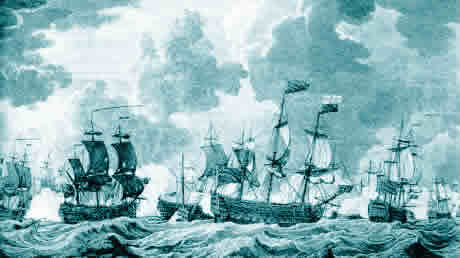
A Cold November Day Marshal Conflans' fleet left Brest on November 14, just as the weather improved enough for the blockading British fleet to reestablish their position after seeking shelter at Torbay. It wasn't until November 17 that Hawke was made aware of Conflans' move, and the Vice-Admiral made haste to Belle Isle, where he expected to find the fugitive French fleet.
"Concluding that their first rendezvous would be Quiberon, the instant I received the intelligence I directed my course tither with pressed sail. At first, the wind was driving hard at south by east and south, and drove us considerably westward. But on the 18th and 19th, though variable, it proved more variable." (Hawke, 1759)
At 0830 on the 20th, the frigate Maidstone signaled that it had spotted the French fleet, which was indeed off of Belle Isle. The French had engaged a small squadron of frigates and bombs under Commodore Duff which had been blockading French transports in the Gulf of Morbihan. When the approaching British fleet was sighted, Duff's crew cheered in relief, and the French broke off pursuit.
Marshal Conflans directed his fleet to retreat to Quiberon Bay. The objective was for the French to take up defensive positions among the dangerous shoals abundant in the bay. The French would use the rough seas and their own familiarity of the region to their advantage. A sound theory to be sure, unfortunately, the French were not talented enough to execute the plan.
When Hawke sighted the French fleet, he ordered his ships into line and began the pursuit. In these conditions, the superior seamanship of the British allowed the Royal Navy to carry more sail than their French counterparts. The French were caught before they could enter the bay and assume their defensive posture. |