
Aftermath
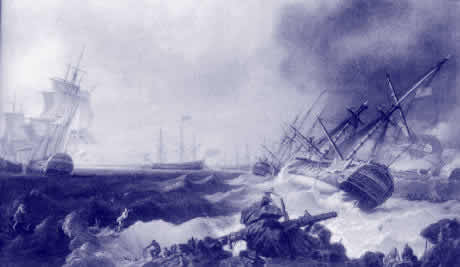
Marshal Conflans' orders to break out the transport fleet from Morbihan at all costs was flawed from the start. Seeking refuge in dangeous waters with an inadequate crew all but insured failure, and Bauffremont's withdrawal meant in defeat, the French would not bring down a commensurate number of British ships.
It is probable that Conflans did not expect the arrival of the Royal Navy so soon. Vice-Admiral Hawke's perserverance, skill, and daring caught the French before any preparations could be made. Indeed, the French line was in such disarray entering Quiberon Bay that Hawke made no pretense to maintain formation, ordering is ships to attack at will.
Vice-Admiral Edward Hawke sums up the challenge nicely in one, rambling sentence:
"Indeed, my lord, had you been in the action, I am of the opinion you would have thought it a miracle that half our ships were not on shore, they were all so keen in the pursuit of the enemy, in a winter's day and hard squalls, upon their own coast, which we were all unacquainted with." (Hawke, 1759, in a letter to Lord Anson)
 The Year that Was - 1759
April 13- French forces defeat Ferdinand of Brunswick at Brunswick.
July 23 - Russian army defeats Prussians at Kay.
August 1- Ferdinand of Brunswick defeats French at Battle of Minden.
August 12 - Frederick the Great suffers major loss versus Russian and Austrian armies at the Battle of Kunersdorf.
September 13 - French Canada falls to British after Battle of the Plains of Abraham outside of Quebec City.
French abandon Fort de la Presque Isle in Lake Erie, subsequently rebuilt by British.
British capture Guadeloupe Island in the French West Indies.
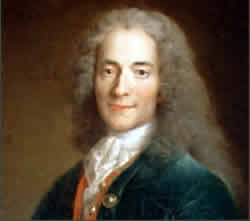
Voltaire publishes Candide.
Adam Smith publishes Theory of Moral Sentiments
Irish brewer Arthur Guiness founds a Dublin brewery that will become the world's largest.
Jospeh Haydn composes Symphony No.1 in D-Major. The "Father of the Symphony" would go on to publish 107 symphonies, in addition to vast volume of other works.
George Handel, baroque composer, died (b.1685)
The first life-insurance company in North America, the Corporation for the Relief of Poor and Distressed Presbyterian Ministers and of the Poor and Distressed Widows and Children of Presbyterian Ministers, was founded in Philadelphia.
George Washington inherits Mt. Vernon from deceased brother, marries Martha Custis, making him one of the wealthiest men in Virginia.
Article Credits Author Jeff Vitous Image Credits Introduction - Paton, "Quiberon Bay" (National Maritime Museum ref. BHC2266). Lyon, David Sea Battles in Close-up: The Age of Nelson (Naval Institute Press, Annapolis, MD:1997) Very well done book covering a variety of battles from the Age of Sail, complete with OOBs.
Hepper, David J. British Warship Losses in the Age of Sail 1650-1859
Marcus, Geoffrey. Quiberon Bay. Barre 1963, Barre Publ co, lst US ed w/DJ, 6x9, VG/VG/ 212 pp, map.
Boudroit, Jean. History of the French Frigate 1650-1850.
Hillsdale College has made available 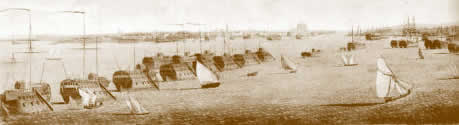
Dramatis Personae - Portrait of Vice-Admiral Edward Hawke (National Maritime Museum neg. A1594).
Prelude to Battle - Source: Rene Chartrand and Eugene Leliepvre, Louis XV's Army, Colonial and Naval Troops (Osprey Men-at-Arms Series #313).
Orders of Battle - Source: David Lyon, Sea Battles in Close-up: The Age of Nelson (Naval Institute Press).
A Cold November Day - Monamy Swain's Quiberon Bay showing Hawke's flagship the Royal George. (National Maritime Museum neg 5639).
Battle Highlights - Map, Original source not known. Acquired from Maps and Gazetteers for Genealogy Research at Ancestry.com
Aftermath - Wright's "Battle of Quiberon Bay", (National Maritime Museum ref BHC0402).
The Year that Was - 1759 - portrait of Voltaire (Microsoft Encarta)
Article Credits - D. Turner's view of prisoner of war ships, Portsmouth harbor (National Maritime Museum ref. BHC1925)